The Invisible Lift
Hidden Incisions. Visible Change.
An endoscopic approach to brow, midface, and neck rejuvenation — performed through a few small, camera-guided incisions hidden in the hairline, with no long scar and no skin removed.
- 3 Areas treated: brow, face, neck
- <1cm Typical incision length
- ~1 week Typical downtime
You’re Not Ready
for a Full Facelift.
A heavier brow. The first hint of jowl. A neck that has started to soften. These are early signals — real, but not yet the kind of change that calls for a deep plane facelift or the removal of excess skin. Your own skin still has the elasticity to redrape well; what has shifted is the tissue underneath it.
The Invisible Lift is built for exactly this stage. Using an endoscope — a small camera that lets Dr. Huq see and work on the deeper tissue directly — the brow, midface, and neck can be repositioned through a handful of incisions small enough to disappear into the hairline and behind the ear.
A deep plane facelift is built to remove excess skin and reposition significantly descended tissue — the right answer once aging has progressed. The Invisible Lift solves a different problem: tissue that has begun to soften and drop, in skin that does not yet need to be removed.
Working through an endoscope rather than a long open incision means Dr. Huq repositions what has moved without cutting away what does not yet need to go. Natural results, read as rested — not operated on.
A Camera.
A Few Small Portals. No Long Incision.
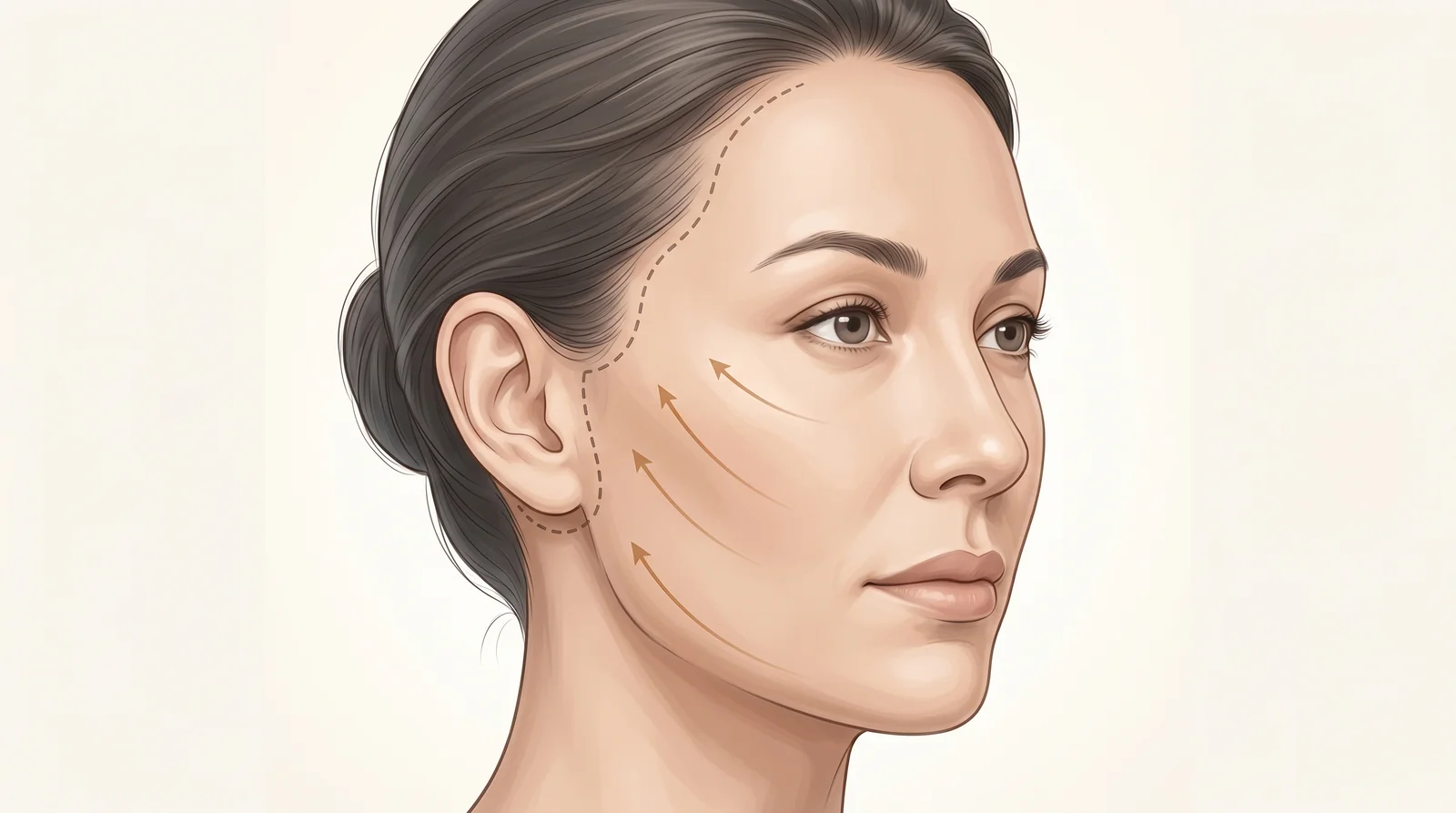
Two to four small incisions — most hidden within the hairline, one or two behind the ear — allow Dr. Huq to insert an endoscope and work on a magnified, real-time view of the deeper tissue, rather than through a long open incision.
In the brow, this means releasing the muscles that pull it down and heavy and re-suspending it into a more open, rested position. In the midface, the deeper fat pad and connective tissue are repositioned upward. In the neck, the vertical muscle bands are tightened through a single small incision beneath the chin. Any one area can be treated alone, or combined in the same surgery.
Because the skin itself is repositioned rather than cut away, incisions are smaller, healing is faster, and — once healed — nearly invisible.
Best Suited to Earlier Signs of Aging.
Brow Heaviness
A low or heavy brow that reads as tired or unhappy, without deep forehead lines to match.
Early Jowling
Mild to moderate softening along the jawline, without the excess skin a full facelift is built to remove.
Early Neck Banding
The first vertical muscle bands or loss of jawline definition in the neck.
Good Skin Elasticity
Skin that will redrape well once the tissue beneath it is repositioned — typically patients in their 40s to mid-50s.
Non-Smokers
Candidates should quit smoking well before the procedure to support healing.
Realistic Expectations
The Invisible Lift refines and restores. In more advanced aging, Dr. Huq may instead recommend a deep plane facelift.
Days, Not Weeks,
Before You Feel Presentable.
Because the incisions are small and no skin is removed, swelling and bruising are typically lighter than after an open facelift, and most patients feel comfortable returning to work or social settings within about a week.
Areas treated together — brow, midface, and neck — are still performed as a single, combined recovery: there is no need to stagger the procedures or heal from each one separately.
As with all of Dr. Huq’s facial procedures, the final result settles gradually over the following weeks as any residual swelling resolves.

What exactly is an endoscopic lift?
An endoscopic lift uses a small camera (endoscope) inserted through a few small incisions, giving Dr. Huq a magnified, direct view of the deeper tissue without a long open incision. The muscle and connective tissue of the brow, midface, and neck are released and repositioned through these small portals rather than through a long incision along the hairline and ear.
How is this different from a deep plane facelift?
A deep plane facelift is performed through a longer incision along the hairline and ear, and includes removal of excess skin — it is the right choice once aging has progressed to moderate or significant skin laxity. The Invisible Lift is endoscopic: smaller incisions, no skin removed, and tissue repositioned under camera guidance. It suits patients with good skin elasticity whose main concern is deeper tissue descent rather than excess skin. Dr. Huq will recommend whichever approach matches your anatomy at your consultation.
Can the brow, face, and neck really be treated in one surgery?
Yes. Each area can be treated on its own, or combined in a single surgery and a single recovery — a common approach for patients seeing early signs in more than one area at once. Dr. Huq will discuss which combination makes sense for your anatomy and goals.
What does it cost?
Pricing depends on which areas are combined and your specific anatomy. As with all of Dr. Huq’s procedures, your quote is all-inclusive — surgeon, facility, and anesthesia — and provided after your consultation.
Am I a candidate?
The best candidates are typically in their 40s to mid-50s, with good skin elasticity and early signs of brow heaviness, jowling, or neck banding — not yet the degree of skin laxity a full facelift is designed to address. Candidates should be non-smokers in good general health with realistic expectations.
Catch It Early.
Keep It Invisible.
Your consultation begins with our Patient Care Coordinator, who will listen to your goals and review your medical history. You will then sit down one-on-one with Dr. Huq, who will assess your anatomy and help you decide whether The Invisible Lift, the Optimum LIFT™, or a deep plane facelift is the best match.