Skin Cancer Removal —
Preserving Function and Appearance.
Over 80,000 cases of skin cancer are diagnosed in Canada each year, including more than 5,000 melanomas. About 80% appear on the face, head, or neck. A plastic surgeon can remove the growth while preserving appearance and function. A physician referral is required to see Dr. Huq for skin cancer removal or the removal of a benign lesion.
- 80,000+ Canadian cases per year
- ~80% Appear on face/head/neck
- 28+ Years in practice
Removal and
Reconstruction in One Team.
A plastic surgeon can play a role in the diagnosis and treatment of skin cancer and other skin growths. If you are concerned about a changing mole, a new growth, or unusual discolouration anywhere on your body, don’t hesitate to consult with Dr. Huq in Niagara Falls.
This includes the surgical removal of benign lumps and bumps — see our Benign Lesion Removal page for pricing — in addition to skin cancers and suspicious growths.
A plastic surgeon can surgically remove a growth in a manner that maintains function and offers the most pleasing final appearance — a consideration that may be especially important if the cancer is in a highly visible area like the face, nose, ear, or lip.
Your Risk
Is Greater
If…
Fair Skin
Your skin is fair and freckles easily.
Light Hair & Eyes
You have light-coloured hair and eyes.
Many or Unusual Moles
You have a large number of moles, or moles of unusual size or shape.
Family or Personal History
You have a family history of skin cancer or a personal history of blistering sunburn.
Outdoor Exposure
You spend a lot of time working or playing outdoors.
Past Radiation Treatment
You received therapeutic radiation treatments for adolescent acne.
Three Forms,
Three Behaviours.
Basal cell carcinoma is by far the most common and the least dangerous. It tends to grow slowly and rarely spreads beyond its original site — but can grow deep into underlying tissue and bone if left untreated.
Squamous cell carcinoma is the next most common, frequently appearing on the lips, face, or ears. It sometimes spreads to distant sites — including lymph nodes and internal organs — and can become life-threatening if not treated.
Malignant melanoma is the least common, but its incidence is rising rapidly. It is the most dangerous type of skin cancer. If caught early, it can be completely cured. If not, it may spread throughout the body and is often deadly.
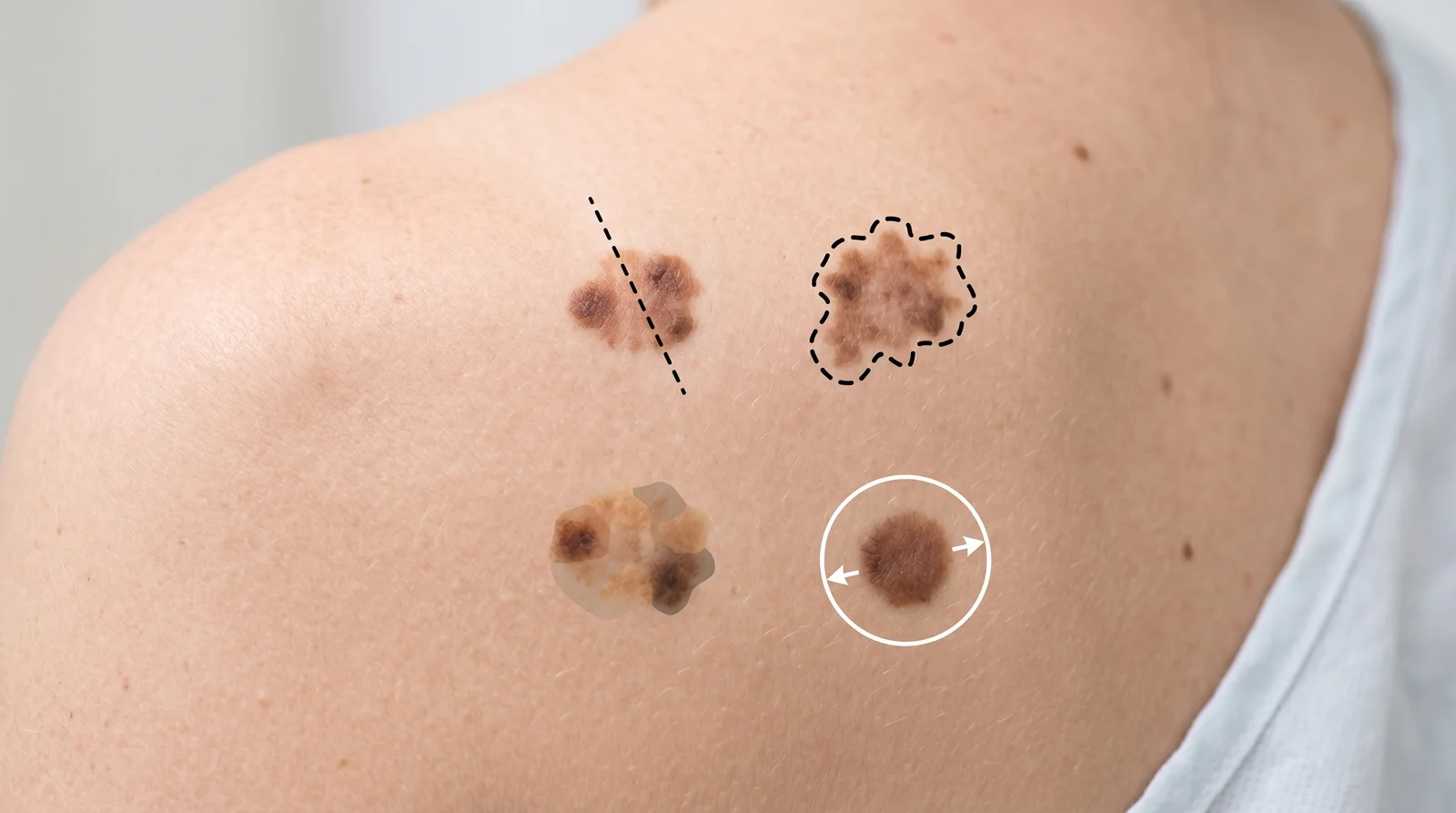
Asymmetry — a growth with unmatched halves. Border — irregular, ragged, or blurred edges. Colour — mottled in appearance, with shades of tan, brown, and black, sometimes mixed with red, white, or blue. Diameter — more than six millimeters across (pencil-eraser size), or any unusual increase in size.
If you notice an unusual growth yourself, consult a plastic surgeon or dermatologist. Both are skilled at diagnosing and treating skin cancer and other skin growths.
Most Skin Cancers
Are Removed
Surgically.
Skin cancer is diagnosed by removing all or part of the growth and examining its cells under a microscope. Most are treated surgically by a plastic surgeon or dermatologist. If the cancer is small, the procedure can be done quickly and easily in an outpatient facility or office, under local anesthesia.
The procedure may be a simple excision, which usually leaves a thin, barely visible scar. Or curettage and desiccation — scraping the cancer out with an electric current to control bleeding and kill any remaining cancer cells, leaving a slightly larger white scar. In either case, the surgical risks are low.
If the cancer is large or has spread, major surgery may be required. Other options include cryosurgery, radiation therapy, topical chemotherapy, and Mohs surgery — shaving the cancer off layer by layer, often followed by a reconstructive procedure.

Do I need a referral to see Dr. Huq?
Yes. A physician referral is required to see Dr. Huq for skin cancer removal or the removal of a benign lesion. Ask your family doctor or physician to send a referral to Niagara Plastic Surgery Centre.
Is skin cancer removal covered by OHIP?
Skin cancer removal is covered by OHIP. The removal of benign moles, skin tags, lipomas, and cysts, however, is considered an uninsured service and is subject to a fee — see Benign Lesion Removal for current pricing.
Why see a plastic surgeon for skin cancer removal?
A plastic surgeon can remove the growth while preserving function and producing the most pleasing final appearance. This is especially important for cancers in highly visible areas — the face, nose, lip, ear — where the reconstruction of surrounding tissue matters as much as the removal itself.
What if my cancer has already been treated by someone else?
Reconstructive techniques — from simple scar revision to complex transfer of tissue flaps — can often repair damaged tissue and rebuild parts of the face. A plastic surgeon can be an important part of the treatment team regardless of who performed the initial removal.
How can I prevent a recurrence?
Avoid prolonged sun exposure — especially between 10 AM and 2 PM and in summer. UV rays pass through water and clouds and reflect off sand and snow. Wear long sleeves and a wide-brimmed hat when outside for long periods. Use sunscreen with SPF 30 or higher and reapply often. Examine your skin regularly and consult your physician about any suspicious change.
If You Notice
a Change —
Come In.
If you’re concerned about a changing mole, a new growth, or unusual discolouration, ask your family doctor or physician for a referral to Dr. Huq. A physician referral is required to see Dr. Huq for skin cancer removal or the removal of a benign lesion.